
Piano Keyboard Chords PDF: A Comprehensive Guide
This guide simplifies finding piano chords, offering step-by-step formulas and downloadable PDF cheat sheets for instant chord identification. Explore resources for beginners!
Understanding Piano Chords
Piano chords are the building blocks of countless songs, representing harmonious combinations of notes played simultaneously. Grasping their structure is fundamental for any aspiring pianist. These aren’t simply random note groupings; they follow specific formulas based on intervals – the distance between notes. Understanding these intervals unlocks the ability to construct chords independently, moving beyond rote memorization.
Essentially, a chord’s character—whether it sounds happy (major) or sad (minor)—stems from these interval relationships. The core concept revolves around the root, which names the chord, and subsequent notes built upon it. Learning to identify these foundational elements is crucial. Furthermore, recognizing how chords function within musical progressions allows for improvisation and composition.
Many resources, including PDF charts, visually represent these relationships, aiding in quick reference and comprehension. These charts often display chords across the keyboard, making it easier to visualize finger placements and understand the overall layout.
What are Piano Chords?
Piano chords are formed when three or more notes are played together, creating a harmonic unit. Unlike simply playing individual notes, chords provide depth and richness to music. They are the foundation of harmony, allowing for complex and emotionally resonant musical expressions. Understanding chords isn’t about memorizing shapes, but recognizing the intervals between the notes.
These intervals, measured in whole and half steps, define the chord’s quality – major, minor, diminished, or augmented. A chord’s name is derived from its root note, the foundational note upon which the others are built. PDF chord charts are invaluable tools for visualizing these combinations across the piano keyboard.

They offer a quick reference for common chords, displaying finger positions and note arrangements. Learning to read these charts empowers musicians to quickly identify and play chords, accelerating their musical journey and expanding their repertoire.
Major vs. Minor Chords

Major chords generally evoke feelings of happiness and stability, while minor chords often convey sadness or tension. This emotional difference stems from the interval between the root and the third. Major chords have a major third, creating a brighter sound, while minor chords possess a minor third, resulting in a darker tone.
Visually, on a piano keyboard, the difference is subtle but crucial. PDF chord charts clearly illustrate these distinctions, showing the precise finger placements for each chord type. Mastering both major and minor chords is fundamental for any pianist, providing the building blocks for countless songs.
Understanding this contrast allows musicians to intentionally manipulate emotions within their music. A simple switch from a major to a minor chord can dramatically alter the mood of a piece, demonstrating the power of harmonic variation. Utilizing piano chord resources is key to grasping these concepts.
Chord Construction Basics
Chord construction revolves around understanding the core components: the root, third, and fifth. The root defines the chord’s name, acting as its foundation. The third determines whether the chord is major or minor, influencing its emotional quality. The fifth adds stability and completes the basic triad.
Piano keyboard chords PDF charts visually represent these intervals, making it easier to identify and play them. A chord isn’t simply a random collection of notes; it’s a structured arrangement built upon these intervals.
Chord inversions rearrange these notes, placing a different note in the bass, altering the sound and creating smoother transitions between chords. Learning to build chords from scratch, and then exploring inversions, is crucial for developing a strong harmonic understanding. These concepts are often detailed in comprehensive piano resources;
Root, Third, and Fifth
Root, third, and fifth are the building blocks of most basic piano keyboard chords. The root is the foundational note – the chord’s namesake. To find the third, count up four half steps (two whole steps) from the root on the piano. The fifth is found by counting seven half steps (three and a half steps) from the root.
Understanding these intervals is key to constructing any chord. Piano chord PDF resources often visually highlight these intervals, simplifying the process. For example, a C major chord consists of C (root), E (third), and G (fifth).
Mastering these three notes unlocks a vast library of chords. These intervals are consistently applied, regardless of the key or chord type, making them fundamental to piano harmony.
Chord Inversions
Chord inversions rearrange the order of notes within a chord, placing a different note than the root in the bass. This alters the chord’s sound and creates smoother transitions between chords. The first inversion places the third in the bass, while the second inversion puts the fifth in the bass.
Piano chord PDF charts often demonstrate inversions visually, showing how the same chord can be voiced differently. Understanding inversions is crucial for creating varied and interesting piano arrangements. They add harmonic color and allow for more fluid voice leading.
Inversions don’t change the chord’s fundamental quality (major or minor), but they do affect its perceived function within a progression. Mastering inversions expands your harmonic palette and improves your piano playing.

Essential Piano Chords for Beginners
Beginner piano learning thrives on mastering fundamental chords. PDF charts provide accessible resources for quickly grasping major and minor chord structures, building a solid foundation.
Major Chords: The Foundation
Major chords form the bedrock of countless songs, offering a bright and cheerful sound. Understanding these is crucial for any aspiring pianist. Utilizing piano chord PDF resources simplifies learning these essential building blocks. These charts visually represent the finger positions for each chord, making practice more efficient.
We’ll focus on three foundational major chords: C Major, G Major, and D Major. Each chord is constructed using the root, third, and fifth notes of the major scale. PDF guides often include diagrams showing these notes on the keyboard, alongside suggested fingerings. Mastering these chords allows you to play a wide variety of popular songs and begin to understand basic harmonic principles.
Consistent practice with these chords, aided by readily available piano chord PDF materials, will quickly build your confidence and musicality. Remember to focus on clean transitions between chords and developing a strong sense of rhythm. These initial chords unlock a world of musical possibilities!
C Major Chord
The C Major chord is arguably the most fundamental chord in music, often the first one beginners learn. A piano chord PDF will visually demonstrate its simplicity: it consists of the notes C, E, and G. To play it, place your thumb (1) on C, your middle finger (3) on E, and your pinky (5) on G.
Many piano chord PDF charts will show this arrangement clearly, often with keyboard diagrams indicating the exact keys to press. This chord is bright and uplifting, frequently used in countless popular songs. Practicing the C Major chord builds finger strength and coordination.
Utilize piano chord PDF resources to reinforce your learning and ensure correct finger placement. Experiment with different inversions of the C Major chord to expand your harmonic understanding. Mastering this chord is a significant first step towards playing the piano proficiently and enjoying the world of music!
G Major Chord
The G Major chord, a cornerstone of many songs, is readily accessible through piano chord PDF resources; It’s formed by the notes G, B, and D. On the piano, position your middle finger (3) on G, your index finger (2) on B, and your thumb (1) on D.
A helpful piano chord PDF will illustrate this finger placement visually, making learning easier. This chord possesses a bright and resonant quality, frequently employed in folk, country, and pop music. Consistent practice with the G Major chord enhances dexterity and musicality.
Refer to piano chord PDF charts to confirm correct note selection and finger positioning. Explore inversions of the G Major chord to broaden your harmonic palette. Successfully playing the G Major chord unlocks a vast repertoire of songs and strengthens your foundational piano skills, paving the way for musical expression.
D Major Chord
The D Major chord, a frequently used chord in various musical genres, is easily learned with the aid of a piano chord PDF. This chord consists of the notes D, F#, and A. On the piano, place your middle finger (3) on D, your index finger (2) on F#, and your thumb (1) on A.
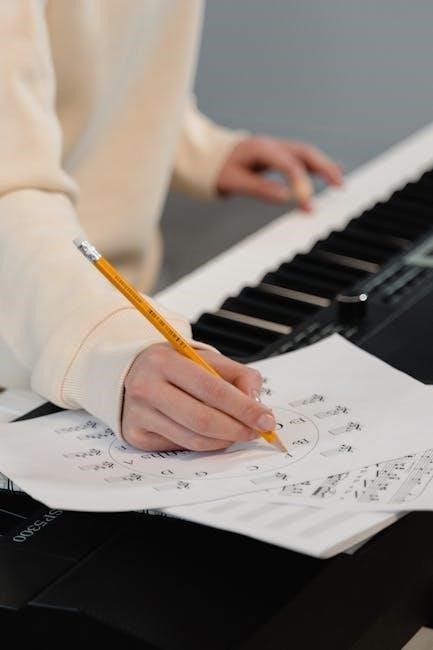
A clear piano chord PDF will visually demonstrate the correct finger placement, accelerating the learning process. The D Major chord offers a cheerful and uplifting sound, commonly found in pop, country, and classical pieces. Regular practice with this chord improves hand coordination and musical understanding.
Utilize piano chord PDF charts to verify accurate note selection and finger positioning. Experiment with different inversions of the D Major chord to expand your harmonic options. Mastering the D Major chord opens doors to countless songs and solidifies your fundamental piano abilities, fostering musical creativity.
Minor Chords: Adding Emotion
Minor chords introduce a melancholic or emotional quality to your playing, contrasting with the brighter sound of major chords. A piano keyboard chord PDF is invaluable for quickly learning these essential harmonies. They are constructed similarly to major chords, but with a lowered third. This subtle change dramatically alters the chord’s character.
Utilizing a PDF chart allows for visual learning of finger placements for common minor chords like A minor, E minor, and D minor. These chords are foundational for playing ballads, blues, and many popular songs. Practicing minor chords alongside major chords builds a well-rounded harmonic vocabulary.
Downloadable piano chord PDFs provide a convenient reference for quick access during practice or performance. Understanding minor chords unlocks a wider range of expressive possibilities, enabling you to convey deeper emotions through your music. Consistent practice is key to mastering these essential building blocks.
A Minor Chord
The A minor chord is a fundamental building block in piano music, frequently appearing in countless songs across various genres. A helpful piano keyboard chord PDF will visually demonstrate its construction and finger positioning. It’s comprised of the notes A, C, and E – the root, minor third, and perfect fifth respectively.
To play it, position your thumb on A, middle finger on C, and pinky finger on E. Many PDF resources illustrate this clearly, aiding in memorization. The A minor chord evokes a sense of sadness or introspection, making it ideal for ballads and emotive pieces.
Referencing a chord PDF allows for quick recall during practice and performance. Mastering the A minor chord is a crucial step towards expanding your harmonic palette and understanding chord theory. Consistent practice with a visual guide will solidify your technique and musicality.
E Minor Chord
The E minor chord is another essential component of piano playing, frequently utilized for its melancholic and expressive qualities. A comprehensive piano keyboard chord PDF will visually guide you through its formation and fingering. This chord consists of the notes E, G, and B – the root, minor third, and perfect fifth.
To play, place your thumb on E, middle finger on G, and pinky on B; Many PDF charts provide clear diagrams for easy learning. The E minor chord is commonly found in popular music and classical compositions, lending a dramatic flair.
Utilizing a chord PDF during practice ensures accuracy and speed. Mastering this chord expands your ability to play a wider range of songs and understand chord progressions. Consistent practice, aided by visual resources, will enhance your musical skills and confidence.
D Minor Chord
The D minor chord is a foundational element for any piano player, offering a somber and emotive tone. A well-structured piano keyboard chord PDF will illustrate its construction and proper fingering. This chord comprises the notes D, F, and A – representing the root, minor third, and perfect fifth respectively.
To execute the chord, position your middle finger on D, index finger on F, and pinky on A. Numerous PDF resources offer visual aids for quick comprehension. The D minor chord frequently appears in ballads and introspective pieces, adding depth and feeling.
Referencing a chord PDF during practice reinforces correct technique and accelerates learning. Mastering this chord unlocks a broader repertoire and enhances your understanding of chord progressions. Regular practice, supported by visual guides, will build your musical proficiency and confidence.

Accessing Piano Chord Charts & PDFs
Piano chord charts and PDFs offer convenient, printable resources for quick reference and learning. Downloadable cheat sheets simplify chord mastery!
Free Printable Piano Chord Charts
Accessing free printable piano chord charts is a fantastic way to begin your musical journey or to supplement existing lessons. Numerous websites offer beautifully designed charts covering a wide range of chords, from basic major and minor triads to more complex seventh and extended chords. These charts typically display the chord diagrams visually, showing you exactly which keys to press on the piano keyboard to create each chord.
The benefit of printable charts lies in their portability and ease of use. You can keep them near your piano for quick reference during practice sessions, take them to lessons, or even laminate them for durability. Many charts are categorized by key or chord type, making it simple to find the chords you need. Look for charts that include fingerings to help you develop efficient and comfortable hand positions. Utilizing these resources can significantly accelerate your chord learning process and boost your confidence at the piano.
Remember to explore various sources to find charts that best suit your learning style and musical goals!
PDF Cheat Sheets for Quick Reference
PDF cheat sheets are invaluable tools for any pianist, offering a condensed and readily available resource for chord information. These downloadable documents typically present chord diagrams in a clear, concise format, allowing for quick and easy lookup during practice, songwriting, or performance. They are especially useful when you need to recall a chord quickly without navigating through lengthy charts or websites.
A good cheat sheet will often categorize chords by key, type (major, minor, seventh, etc.), and sometimes even by musical style. Many include fingerings to guide your hand positioning, promoting efficient playing. The portability of PDFs means you can access them on any device – piano, tablet, or smartphone – making them ideal for on-the-go practice or gigs.
Downloading and printing a selection of cheat sheets tailored to your needs will significantly enhance your chord vocabulary and fluency.
Online Interactive Piano Chord Tools
Interactive piano chord tools offer a dynamic alternative to static PDF charts, providing a more engaging and exploratory learning experience. These web-based applications allow you to visualize chords on a virtual keyboard, often highlighting the notes that comprise each chord. Many tools enable you to select a root note and chord type, instantly displaying the corresponding fingering and notation.
Some platforms even offer audio playback, allowing you to hear the chord’s sound, reinforcing your understanding. These tools are particularly beneficial for beginners, as they provide immediate feedback and help develop ear training. Advanced users can explore complex chord voicings and inversions with ease.
The interactive nature fosters experimentation and accelerates chord recognition, complementing traditional learning methods like PDF cheat sheets and lessons.

Expanding Your Chord Vocabulary
Beyond basic chords, explore seventh and suspended chords to add complexity and emotional depth to your playing, utilizing PDF resources.
Seventh Chords: Adding Complexity
Seventh chords introduce a fourth note to the traditional triad, creating a richer, more nuanced harmonic texture. These chords are fundamental for jazz, blues, and more sophisticated pop arrangements. Understanding their construction opens up a vast world of musical possibilities. Major seventh chords, for instance, add a delicate, jazzy quality, while dominant seventh chords create a strong pull towards resolution, often used in blues progressions.
PDF resources dedicated to piano chords often include comprehensive charts detailing seventh chord voicings across all keys. These charts visually represent the notes within each chord, making it easier to learn and memorize them. Utilizing these PDF cheat sheets allows for quick reference during practice and performance. Learning to identify and play seventh chords is a crucial step in expanding your harmonic palette and creating more compelling musical arrangements. They add color and depth, moving beyond the simplicity of basic triads.
Major Seventh Chords
Major seventh chords possess a unique, sophisticated sound – a major triad with a major seventh interval added. They evoke a sense of elegance and are frequently used in jazz standards, bossa nova, and contemporary pop music. Constructing a major seventh chord involves adding a note that is a major seventh above the root. For example, a Cmaj7 chord consists of C, E, G, and B.
Piano chord PDF resources often dedicate sections to visually representing these voicings across the keyboard. These PDF charts demonstrate various inversions, allowing for smoother transitions and richer harmonic textures. Mastering major seventh chords enhances your ability to create complex and emotionally resonant piano arrangements. They offer a subtle yet powerful alternative to standard major chords, adding a touch of refinement to your playing.
Dominant Seventh Chords

Dominant seventh chords are arguably the most important seventh chord type, creating a strong pull towards resolution. They’re built on a major triad with a minor seventh interval added, resulting in a tense, unstable sound. A G7 chord, for instance, contains G, B, D, and F. This chord is fundamental in blues, jazz, and many popular music styles.
Piano chord PDF guides frequently highlight dominant seventh chords due to their prevalence in common chord progressions. These PDF resources illustrate various voicings and inversions, aiding in smooth transitions and harmonic interest. Understanding dominant seventh chords is crucial for improvisation and songwriting. They naturally lead to the tonic chord, providing a satisfying harmonic resolution. Mastering these chords unlocks a vast world of musical possibilities on the piano.
Suspended Chords: Creating Tension
Suspended chords, often labeled sus2 or sus4, introduce a unique harmonic color by replacing the third of a major or minor chord with a second or fourth interval. This creates a sense of tension and anticipation, as the ear expects the third to eventually resolve. A Csus2 chord, for example, consists of C, D, and G, while Csus4 includes C, F, and G.
Piano chord PDF charts often demonstrate these voicings, showcasing how they differ from standard major and minor chords. These PDF resources are invaluable for understanding the subtle nuances of suspended chords and their application in various musical contexts. They’re frequently used to build harmonic interest and create a floating, unresolved feeling. Mastering suspended chords expands your harmonic palette and adds depth to your piano playing.
Sus2 and Sus4 Chords
Sus2 chords replace the third with a second, creating a lighter, more open sound. For example, a Dsus2 chord consists of D, E, and A. Conversely, Sus4 chords substitute the third with a fourth, generating a stronger sense of tension that begs for resolution. A Dsus4 chord comprises D, G, and A.
Piano chord PDF guides frequently illustrate these voicings, demonstrating their construction and how they differ from major and minor counterparts. These PDF resources are essential for visualizing the intervals and understanding the unique character of each chord. They are commonly used in intros, verses, or as passing chords to add harmonic interest. Learning to identify and play Sus2 and Sus4 chords, using a piano chord chart, significantly enhances your musical expression.
Chord Progressions and Application
Chord progressions are the foundation of songs, and piano chord PDF resources help you understand common sequences across various musical genres for application.
Common Chord Progressions
Understanding common chord progressions is crucial for any pianist, and utilizing a piano chord PDF can significantly accelerate this learning process. Several progressions appear repeatedly across countless songs, forming the backbone of popular music. The I-IV-V progression, for example – in the key of C, this would be C Major, F Major, and G Major – is incredibly prevalent.
Another frequently used progression is the ii-V-I, offering a smoother, more sophisticated harmonic movement. Minor key progressions, like i-VI-III-VII (in A minor: Am-F-C-G), provide a different emotional color. Piano chord PDF charts often visually represent these progressions, making it easier to grasp their structure and how chords relate to one another.
Learning to recognize these patterns by ear, aided by visual references from a PDF, allows you to quickly identify songs and even begin composing your own music. Experimenting with variations of these progressions is a fantastic way to develop your musical ear and creativity.
Using Chords in Different Genres
Piano chord PDFs become invaluable tools when exploring diverse musical genres. Pop music frequently employs simple, bright major chord progressions, often utilizing I-V-vi-IV. Blues relies heavily on dominant seventh chords and the 12-bar blues progression, easily referenced in a chord PDF. Jazz incorporates complex seventh, ninth, and altered chords, demanding a more comprehensive chord resource.
Classical music utilizes a wider harmonic palette, including inversions and secondary dominants, which a detailed piano chord PDF can illustrate. Gospel music often features rich, soulful chords and progressions, frequently incorporating passing chords and embellishments. Country music often uses simple, direct chord changes, making a basic chord PDF sufficient.
Understanding how chords are typically used within each genre allows you to authentically recreate the sound and feel. A well-organized piano chord PDF can be your guide, showcasing genre-specific voicings and common harmonic patterns.
Finding Chords by Ear
Developing your ear is crucial, and a piano chord PDF can aid this process. Start by identifying the root note of a chord – the foundational note. Then, attempt to discern if the chord is major or minor by listening to the overall ‘feel’. A chord PDF can then confirm your suspicions, showing you the corresponding notes.
Practice recognizing intervals – the distance between notes. Is the third major or minor? This distinction defines the chord’s quality. Use a piano chord PDF to visually connect the sound to the notation.
Transcribing simple songs is excellent practice. Slow down the music, isolate chords, and use your chord PDF to check your work. Over time, you’ll internalize chord sounds and be able to identify them quickly, reducing reliance on the PDF and strengthening your musical intuition.
Resources for Learning Piano Chords
Numerous online platforms offer comprehensive piano chord PDF resources and interactive tools. Websites like 8notes and Teoria provide free, printable chord charts and exercises. YouTube channels dedicated to piano instruction often feature tutorials on chord construction and progressions, frequently linking to downloadable PDFs.
Consider utilizing apps like Perfect Ear or Functional Ear Trainer to develop your aural skills, complementing your study of piano chord PDFs. Many piano learning websites offer structured courses, often including chord libraries in PDF format as part of their curriculum.
Don’t underestimate the value of a good piano chord book; these often provide a more organized and in-depth approach than scattered online resources. Remember to consistently practice with your chosen resources and PDFs!